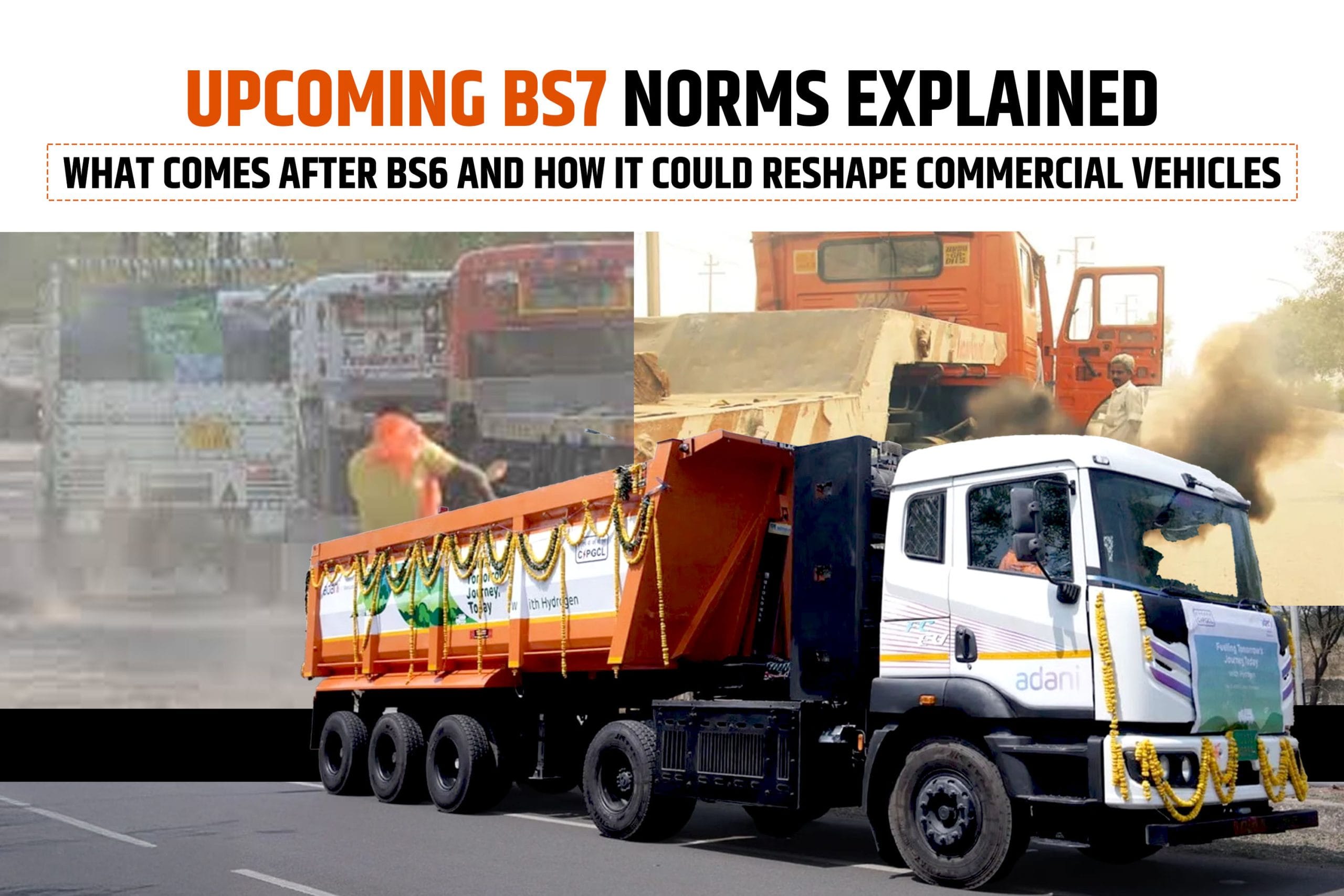
India is still getting used to BS6. Workshops are stocked with AdBlue. Fleet owners have learned, sometimes painfully, how sensitive modern diesel engines can be. And yet, quietly, the next change is already being discussed in policy circles: BS7.
It isn’t in force yet. There’s no official rollout date announced. But manufacturers, suppliers, and regulators are already planning for it because BS7 won’t be a small update. It will likely change how commercial vehicles are built, monitored, and priced.
To understand why, you need to look at where Bharat Stage norms come from in the first place. India’s emission standards are largely derived from European Euro norms. We don’t copy them line by line, but the structure, philosophy, and direction are the same. BS4 aligned with Euro 4. BS6 aligned closely with Euro 6, skipping BS5 entirely in a big regulatory leap in 2020.
BS7, when it arrives, is expected to track Euro 7, which is already being finalised in Europe. That’s important, because Euro 7 isn’t just about tightening numbers. It changes what regulators care about.
Where BS6 Stands Today
Under BS6, commercial vehicles had to drastically cut emissions of:
- Nitrogen oxides (NOx)
- Particulate matter (PM)
- Hydrocarbons and carbon monoxide
For diesel trucks and buses, this meant SCR systems, DPFs, more sensors, and cleaner fuel dependency. BS6 also introduced Real Driving Emissions (RDE) testing in phases, though enforcement has largely focused on lab and controlled conditions so far.
BS6 cleaned up tailpipes, but it still works on a familiar idea: test emissions under defined cycles, certify the vehicle, and check compliance periodically. BS7 is expected to move beyond that comfort zone.
What BS7 is Likely to Change
The biggest shift under BS7 won’t be just lower emission limits, although those will tighten too. The real change is how emissions are measured and enforced.
Euro 7 focuses heavily on real-world emissions over a longer vehicle life. That philosophy is expected to carry into BS7. Instead of asking, “Is the truck clean when it’s new?”, regulators will increasingly ask, “Is it still clean after years of use, overloads, heat, dust, and traffic?”
Some expected changes include:
- Much stricter NOx limits, especially for diesel engines
- Closer alignment of petrol and diesel emission limits, removing the old diesel leniency
- Continuous on-board emission monitoring, not just diagnostics
- Tighter control over emissions during cold starts and low-speed operation, where city trucks and buses spend most of their time
There’s also global discussion around regulating non-tailpipe emissions, such as brake and tyre particulate matter. Whether India adopts that fully under BS7 is still unclear, but it’s on the table.
What This Means for Truck And Bus Manufacturers
For OEMs, BS7 won’t be solved by software tweaks alone. Engines may need to run cleaner even before exhaust treatment kicks in. After-treatment systems will become more complex and more expensive. Calibration margins will shrink.
This also means higher development costs and longer validation cycles. Smaller manufacturers and niche players may find BS7 harder to absorb than large OEMs with global platforms.
Prices will go up. Not dramatically overnight, but enough to matter in a cost-sensitive market like trucking.
What Fleet Owners Should Expect
For fleet operators, BS7 vehicles will likely:
- Cost more upfront
- Be more sensitive to maintenance quality
- Depend even more on proper fuel and fluids
- Generate more data that regulators can access
On the flip side, cleaner vehicles may face fewer restrictions in cities, pollution-control zones, and future low-emission areas. Over time, BS7 could also accelerate the shift toward CNG, LNG, and electric commercial vehicles, simply because compliance becomes easier outside diesel.
When Will BS7 Actually Come?
There is no official notification yet, but industry expectation points to a 2026–27 timeframe at the earliest. Before that, India is still rolling out tighter BS6 sub-phases, including expanded RDE norms.
BS7 won’t arrive suddenly. It will come with draft notifications, consultations, and phased timelines. But once it’s locked in, the direction will be hard to reverse.
Why BS7 Matters Even Before it Exists
BS7 is not just another emission update. It signals that India is moving closer to lifetime emissions control, not just certification-time compliance. For commercial vehicles, that’s a big deal. Trucks and buses are built to last. Under BS7, they may also be expected to stay clean for most of that life. That changes design priorities, ownership costs, and even resale dynamics. BS6 taught the industry how to clean up exhausts. BS7, whenever it comes, will likely test how clean commercial vehicles remain once they’ve actually done the hard work they were built for.
For more articles and news, stay updated with 91trucks. Subscribe to our YouTube channel and follow us on Facebook, Instagram, and Linkedin for the latest videos and updates from the automotive world!
Web Stories
Latest Industry Insights News
 EKA Mobility Records Over 13X Growth in H1 FY27 Volumes, Crosses 1,700 UnitsEKA Mobility recorded a significant rise in vehicle volumes during the first half of FY2026-27, with sales increasing to 1,786 units from 133 units in the corresponding period last year. The company reported a 1,243% year-on-year growth, taking its H...4 min readST
By Saksham
Thu Oct 01 2026
 Protecting Revenue When Commercial Vehicles Are the Backbone of Your BusinessFor many businesses in India, the truck or van parked outside is where the money comes from. When it runs, goods move, deliveries happen, and cash comes in. When it stops, everything slows down. Most owners think carefully about buying the right vehi...9 min readST
By Saksham
Tue Sep 29 2026
 Ganpati Bappa Morya, Time to Bring Home a New IntraGanesh Chaturthi is here, and with it comes a familiar feeling, homes decorated, drums playing in the streets, and Bappa arriving to bless every new beginning. It's the season people pick to start something new, and for a lot of business owners, that...3 min readST
By Saksham
Fri Sep 11 2026
 Mr. India Was Never InvisibleWhat if Mr. India was never fictional? What if the man who could disappear wasn't a superhero at all, but a father somewhere on a highway, hundreds of kilometres away from home?Meet Pari.On Independence Day, a little girl stood on a stage to particip...4 min readST
By Saksham
Mon Aug 17 2026
 Amazon Partners With Eicher Trucks for EV Delivery Expansion in IndiaAmazon India is expanding its fast delivery service through Amazon Now by adding 1000 electric trucks as part of their logistics network. These trucks will be supplied by VE Commercial Vehicles and its subsidiary Eicher Trucks & Buses and will be...4 min readIG
By Indraroop
Thu May 21 2026
 Tata Ace Turns 21; Tata Motors Launches Ace Gold+ XL for Last-Mile LogisticsTata Motors has marked 21 years of its small commercial vehicle, the Tata Ace, with the launch of the new Ace Gold+ XL. The model arrives as an extension of the existing Ace range, aimed at improving load capacity and efficiency in last-mile transpor...3 min readIG
By Indraroop
Wed May 06 2026
 Ashok Leyland Launches Twin Fuel DOST and DOST+ XL in IndiaAshok Leyland has launched two new Light Commercial Vehicles (LCV)- the Twin Fuel DOST and DOST+ XL- which have produced a practical and environmentally-friendly way of last-mile delivery. The launch took place on April 16, 2026, in New Delhi, as par...3 min readIG
By Indraroop
Thu Apr 16 2026
 Tata Motors Lucknow Plant Crosses 10 Lakh Commercial Vehicles MilestoneThe Tata Motors Ltd.'s manufacturing plant located in Lucknow has produced a total of 10th lakh commercial vehicles over the last thirty years and recently celebrated this achievement with a ceremony that was attended by representatives from the Gove...4 min readIG
By Indraroop
Wed Apr 15 2026
 Bajaj Launches WEGO Electric 3-Wheeler Range with Up to 296 km RangeBajaj Auto has released a brand new range of electric three-wheelers called WEGO. According to Bajaj, the company has one of the largest selections of EV three-wheelers in India, with varieties catering to both passenger and freight uses. Five separa...3 min readIG
By Indraroop
Tue Apr 14 2026
 Tata Motors Bags Orders for More Than 5,000 Buses from State Transport UndertakingsTata Motors has received an order from several state transport undertakings (STUs) across India to deliver more than 5,000 buses and/or bus chassis. The order includes transport corporations located in the states of Maharashtra, Gujarat, North Wester...3 min readIG
By Indraroop
Mon Mar 16 2026