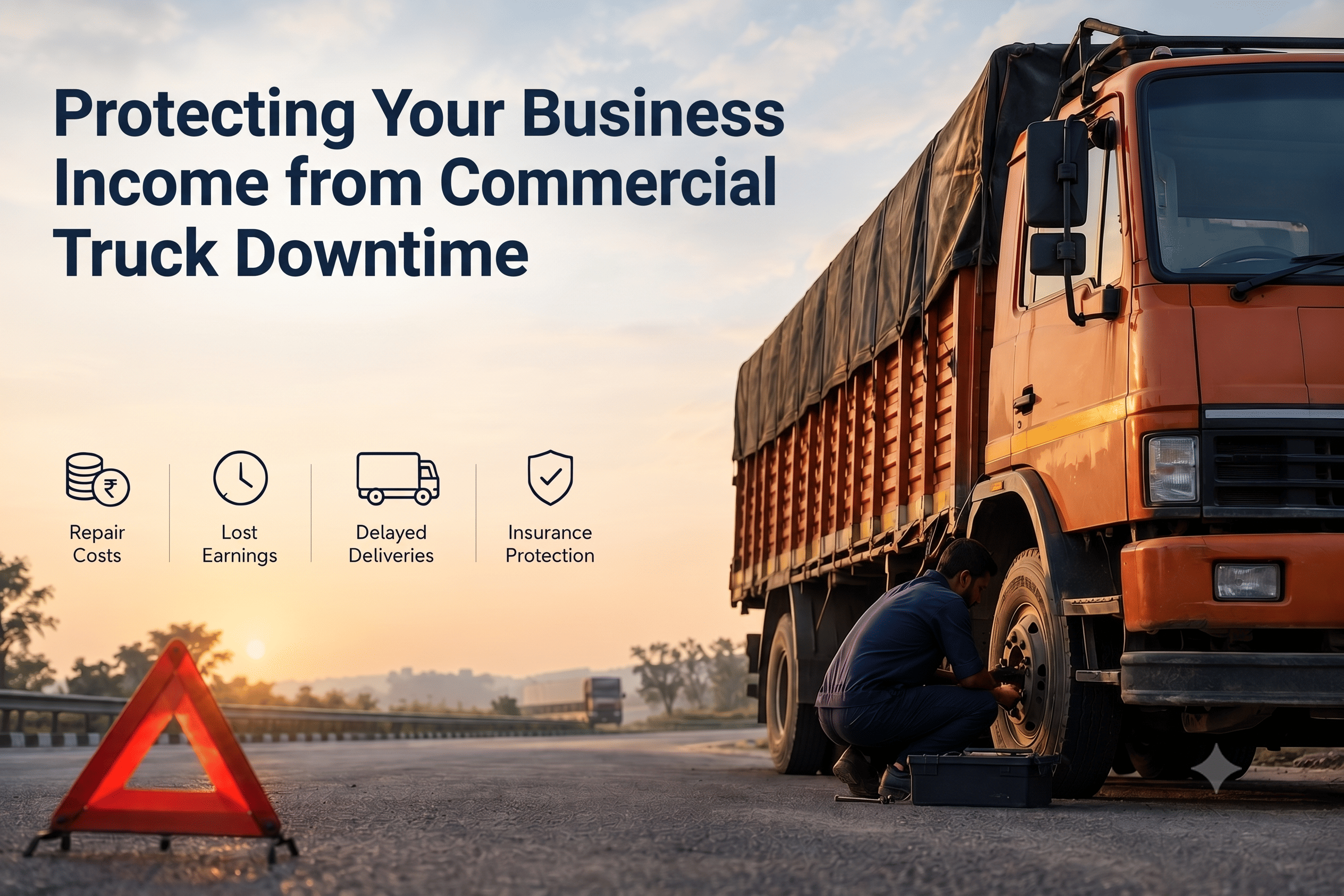
For many businesses in India, the truck or van parked outside is where the money comes from. When it runs, goods move, deliveries happen, and cash comes in. When it stops, everything slows down. Most owners think carefully about buying the right vehicle and hiring good drivers.
But fewer stop to ask what happens to income if that vehicle is suddenly off the road for a week. For transporters, fleet operators, and delivery businesses, vehicle uptime directly affects revenue. Even a short period off the road can disrupt deliveries, customer commitments, and cash flow.
For transporters and fleet operators, understanding these risks is essential because even short periods of vehicle downtime can affect revenue, customer commitments, and day-to-day operations.
Why Are Commercial Vehicles Directly Linked to Business Revenue?
Commercial vehicles are linked to business revenue because they are the main means of moving goods and people from one place to another. Around 65% of India’s freight moves by road, according to Ministry of Road Transport and Highways (MoRTH) figures. So a very large share of everything the country buys and sells sits inside a truck or van at some point in its journey.
For transport, logistics, and delivery businesses, each vehicle is a revenue-generating asset that contributes directly to business income. Every completed trip generates revenue, which is why utilisation and uptime are among the most important profitability metrics for transport businesses.
What Revenue Risks Can Arise When a Commercial Vehicle is Taken Off the Road?
When a commercial vehicle is taken off the road, the biggest risk is lost income, because a parked vehicle cannot earn. These losses come from the market side: the business the vehicle would have brought in but now simply cannot:
- Missed or cancelled orders: Goods that cannot be delivered on time may be refused, returned, or handed to a competitor.
- Penalties for late delivery: Some contracts charge a fine when goods arrive late, turning a delay straight into a cash loss.
- Lost regular clients: A repeat customer who is let down once may quietly move to another supplier, and regular customers are the hardest to win back.
- Missed new work: Fresh orders that arrive while the vehicle is down often have to be turned away.
How Does Vehicle Downtime Create Hidden Costs Beyond the Repair Bill?
Vehicle downtime creates costs that go far beyond the repair bill. The repair is only the visible part. Underneath it sit several costs that keep draining cash even though the vehicle is earning nothing.
Whenever the vehicle is down for repair in a workshop, the driver may still be paid, and any loan EMI due that month still has to be paid. Meanwhile, the deliveries can’t stop, and the owner may end up renting another vehicle or passing the job to another fleet owner. Hiring a replacement vehicle increases operating costs, while outsourcing the assignment to another transporter means losing part or all of the expected revenue from that job.
On top of this, the owner spends hours chasing quotes, approvals, and paperwork instead of running the business. So a repair that looks like a small bill on paper can become a much larger loss once these hidden costs are added.
Why Are Maintenance and Safe Driving Only Part of the Solution?
Good maintenance and safe driving lower the risk of trouble, but they cannot remove it completely. Servicing the vehicle on time, checking tyres and brakes, and driving carefully all reduce the chance of a breakdown or accident.
Even the best-maintained vehicle can be affected by events outside the owner's control, such as accidents involving another driver, theft, fire, flooding, or severe weather. Preventive practices reduce risk, but they do not eliminate the financial impact when unexpected incidents occur.
How Does Commercial Vehicle Insurance Help Protect Business Continuity?
Commercial vehicle insurance helps protect business continuity by covering the cost of damage, so a single accident doesn't empty the business's cash. A comprehensive commercial vehicle insurance plan can help pay for repairs after an accident, fire, theft, or natural disaster, subject to the policy's coverage, limits, and terms and conditions. Without insurance, the repair bill comes straight out of pocket or working capital, the same money that is needed for fuel, driver wages, or the next load. The claim shifts the repair cost to the insurer, so the cash stays available for what it's meant for.
The vehicle might have to be off the road for a bit, but the business doesn't have to go down with it. For a small transport operation, that one difference is what keeps a bad day from turning into a bad week or month.
Which Insurance Features Matter Most for Revenue-Dependent Businesses?
For businesses that depend on their vehicles to earn, the features that matter most are the ones that reduce downtime and out-of-pocket costs. One of the most important decisions is choosing the right type of insurance plan. The table below shows the basic difference between the two main options.
| Coverage | Third-Party | Comprehensive |
| Legal compliance | Yes | Yes |
| Own vehicle damage | No | Covered as per policy terms |
| Fire & natural disasters | No | Covered as per policy terms |
| Theft protection | No | Covered as per policy terms |
| Business continuity support | Limited | Better financial protection against major losses |
| Best suited for | Legal compliance only | Revenue-dependent businesses |
Add-ons such as Zero Depreciation cover, Engine Protection cover, and Roadside Assistance can further reduce unexpected repair expenses and help vehicles return to operation faster after an incident.
How Can Faster Claims Support Get Businesses Back on the Road Sooner?
Faster claims processing reduces the time between damage, repair approval, and vehicle return to service. For commercial vehicle owners, every additional day in the workshop can translate into missed business opportunities and lost revenue.
A few things can speed this up: a cashless repair at a network garage means the insurer settles the bill directly with the workshop, so the owner doesn't have to worry about the large payment. Simple, paperless steps and quick approvals also cut delays. The faster the claim is processed, the sooner the vehicle can return to normal operations. When choosing a policy, claim speed and garage network matter as much as price.
What Can Fleet Owners Do to Strengthen Revenue Protection Across Their Operations?
Fleet owners can strengthen revenue protection by insuring every vehicle properly and then reviewing that coverage as the business grows. A single strong policy on one vehicle does little if three others in the yard are underinsured. A few practical habits go a long way:
- Insure each vehicle for the right value. Set the insured amount close to the vehicle’s fair current value, so a claim reflects what it's really worth.
- Match the cover to the vehicle’s job. A goods truck faces different risks from a passenger van, and a dedicated truck insurance plan can help protect a truck used for deliveries and long-haul goods movement, subject to the policy’s terms.
- Keep papers ready. Keeping registration, permits, and service records in one place speeds up claims and keeps the process smooth.
- Review at every renewal. As vehicles age or the fleet grows, the right cover changes with time.
Treating insurance as a fleet-wide plan, rather than a one-time task for each vehicle, keeps the whole operation protected instead of just one part of it.
Protecting Commercial Vehicles is Ultimately About Protecting Business Growth
For businesses that depend on commercial vehicles, protecting revenue means protecting vehicle uptime. While maintenance and safe driving help reduce risks, unexpected incidents can still disrupt operations and cash flow. The right insurance cover provides financial support when those events occur, helping businesses repair, replace, and return vehicles to service without placing excessive pressure on working capital. For fleet owners and transport operators, that makes insurance an important part of long-term business resilience and growth.
Reference Links & Resources
- Publisher: https://www.91trucks.com/
- Header Image Source: https://www.magnific.com/free-photo/trucks-minibuses-located-inside-ferryboat-greece_11085973.htm#fromView=search&page=1&position=3&uuid=6c572ccc-0f3e-402b-876d-d0d83d87e1bd&track=ais_hybrid&query=Commercial+Vehicles+Are+the+Backbone
- MoRTH Statistics: https://www.impriindia.com/insights/ministry-road-transport-highways-morth/
- Business Case for Revenue Protection: https://www.moneycontrol.com/mc-buzz/the-business-case-for-protecting-revenue-in-commercial-transport-operations-article-14011103.html
- Importance of Insurance: https://www.cilanka.com/the-importance-of-commercial-vehicle-insurance-for-your-business-operations/
- Downtime Risks: https://business.michelinman.com/blog/articles/downtime-the-silent-killer-of-commercial-fleet-profitability
- Insurance as a Key to Protection: https://www.linkedin.com/pulse/commercial-vehicle-insurance-key-protecting-bxfcc
Web Stories
Latest Industry Insights News
 Ganpati Bappa Morya, Time to Bring Home a New IntraGanesh Chaturthi is here, and with it comes a familiar feeling, homes decorated, drums playing in the streets, and Bappa arriving to bless every new beginning. It's the season people pick to start something new, and for a lot of business owners, that...3 min readST
By Saksham
Fri Sep 11 2026
 Mr. India Was Never InvisibleWhat if Mr. India was never fictional? What if the man who could disappear wasn't a superhero at all, but a father somewhere on a highway, hundreds of kilometres away from home?Meet Pari.On Independence Day, a little girl stood on a stage to particip...4 min readST
By Saksham
Mon Aug 17 2026
 Amazon Partners With Eicher Trucks for EV Delivery Expansion in IndiaAmazon India is expanding its fast delivery service through Amazon Now by adding 1000 electric trucks as part of their logistics network. These trucks will be supplied by VE Commercial Vehicles and its subsidiary Eicher Trucks & Buses and will be...4 min readIG
By Indraroop
Thu May 21 2026
 Tata Ace Turns 21; Tata Motors Launches Ace Gold+ XL for Last-Mile LogisticsTata Motors has marked 21 years of its small commercial vehicle, the Tata Ace, with the launch of the new Ace Gold+ XL. The model arrives as an extension of the existing Ace range, aimed at improving load capacity and efficiency in last-mile transpor...3 min readIG
By Indraroop
Wed May 06 2026
 Ashok Leyland Launches Twin Fuel DOST and DOST+ XL in IndiaAshok Leyland has launched two new Light Commercial Vehicles (LCV)- the Twin Fuel DOST and DOST+ XL- which have produced a practical and environmentally-friendly way of last-mile delivery. The launch took place on April 16, 2026, in New Delhi, as par...3 min readIG
By Indraroop
Thu Apr 16 2026
 Tata Motors Lucknow Plant Crosses 10 Lakh Commercial Vehicles MilestoneThe Tata Motors Ltd.'s manufacturing plant located in Lucknow has produced a total of 10th lakh commercial vehicles over the last thirty years and recently celebrated this achievement with a ceremony that was attended by representatives from the Gove...4 min readIG
By Indraroop
Wed Apr 15 2026
 Bajaj Launches WEGO Electric 3-Wheeler Range with Up to 296 km RangeBajaj Auto has released a brand new range of electric three-wheelers called WEGO. According to Bajaj, the company has one of the largest selections of EV three-wheelers in India, with varieties catering to both passenger and freight uses. Five separa...3 min readIG
By Indraroop
Tue Apr 14 2026
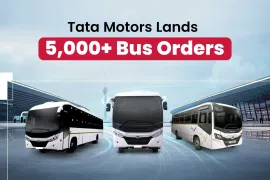 Tata Motors Bags Orders for More Than 5,000 Buses from State Transport UndertakingsTata Motors has received an order from several state transport undertakings (STUs) across India to deliver more than 5,000 buses and/or bus chassis. The order includes transport corporations located in the states of Maharashtra, Gujarat, North Wester...3 min readIG
By Indraroop
Mon Mar 16 2026
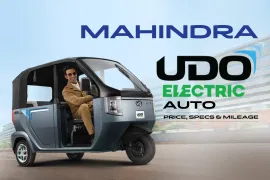 Mahindra UDO Electric Auto Price Rs. 3.59 Lakh – Specs and MileageMahindra UDO, an Electric Three-Wheeler, has been officially launched in India, with an introductory price tag of Rs. 3.58-3.59 lakhs. This new model joins the highly evolving and dynamic space of last-mile mobility with a singular focus on range, co...3 min readIG
By Indraroop
Fri Feb 13 2026