
The movement of goods between Nepal and India relies heavily on cross-border trucking. Understanding the regulations governing this crucial trade route is essential for transporters on both sides. This guide provides a comprehensive overview of the key rules and considerations for commercial vehicle operation between the two countries.
Legal Framework
The foundation of Nepal-India trade and transit is the Treaty of Trade and Transit between the two nations. This treaty outlines the broad framework for the movement of goods, including provisions related to transportation. It's crucial for transporters to be familiar with the latest version of this treaty and any associated protocols or agreements. You can find the treaty details on the Ministry of External Affairs website of India. The Indian Embassy in Kathmandu also provides information regarding the entry of Indian registered vehicles into Nepal.
Entry of Indian-Registered Vehicles into Nepal
Indian-registered commercial vehicles, such as trucks and lorries, are permitted to enter Nepal under specific conditions:
- Temporary Importation: These vehicles can be temporarily imported into Nepal upon payment of the applicable customs duty.
- Duration of Stay: A vehicle is allowed to remain in Nepal for a maximum of 30 days within a calendar year. This period cannot be extended, even with additional charges.
- Day Visits: For visits limited to the nearest municipal area or market in Nepal, vehicles can enter without paying customs duty. However, owners must register their vehicle at the Nepalese border check post and obtain a 'Day Pass' or 'Challan'. The vehicle must return to India on the same day, and the pass must be surrendered upon exit.
- Extended Stays: For travel beyond the nearest Nepali town or for overnight stays, vehicles must register for the intended number of days and pay charges ranging from NPR 100 to NPR 500 per day, depending on the vehicle type. The issued pass should be retained for inspection and surrendered upon departure from Nepal.
- Overstay Protocol: If a vehicle needs to stay beyond the permitted period due to unforeseen circumstances, the owner should promptly contact the nearest Nepalese Customs Office (Bhansar) to request an extension before the current pass expires. In Kathmandu, extensions can be processed at the Nepal Customs office located at the Tribhuvan International Airport Cargo complex.
- Compliance: Vehicles found without a valid pass or with an expired pass are considered illegally present in Nepal. Such vehicles are subject to seizure and confiscation by authorities, leading to potential auctioning by Nepal Customs.
Entry of Nepal-Registered Vehicles into India
Nepalese commercial vehicles have specific provisions for entering India:
- Access to Border Areas: Nepalese vehicles, including trucks, can freely access the nearest municipal town, marketplace, or railhead in India without obtaining a permit, provided they return to Nepal on the same day. No levies or taxes are imposed for such short visits.
- Extended Travel: For journeys beyond the nearest Indian town or for stays exceeding one day, vehicle owners must secure a 'Vehicle Permit' from the Embassy of India in Kathmandu, the Consulate General of India in Birgunj, or the Embassy's Camp Office in Biratnagar. These permits are not issued by Nepalese authorities.
- Permit Details: Permits are available for durations of up to 3 or 6 months and can be issued for single, double, or multiple entries. The application process involves paying specified fees and providing a bank guarantee. Upon entering and exiting India, the permit must be stamped at the respective border check posts.
- Application Process: For vehicles registered in the zones of Narayani or Janakpur (with registration prefixes 'Na' and 'Ja'), applications should be submitted to the Consulate General of India in Birgunj. Applications are accepted on working days between 0930 and 1230 hours, with permits typically issued within three working days. Necessary forms and detailed information are available on the Consulate's website.
Staying Updated

Regulations governing cross-border trucking can change. It's essential for transporters to stay updated on the latest rules and procedures. Regularly checking official government websites and consulting with relevant authorities can help ensure compliance.
Conclusion
Navigating the complexities of Nepal-India cross-border trucking requires careful attention to detail and adherence to regulations. By understanding the legal framework, vehicle requirements, documentation needs, and operational considerations, transporters can ensure smooth and efficient movement of goods between the two countries. Staying informed about updates and working with reliable partners are key to success in this vital trade route. Stay tuned with 91trucks for all the latest news and updates related to new launches, commercial vehicles and industry insights. 91trucks is the fastest-growing digital platform aimed at providing you with the latest updates and information related to the commercial vehicle industry.
Web Stories
Latest Trucks News
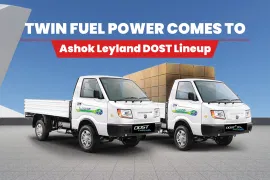 Ashok Leyland Launches Twin Fuel DOST and DOST+ XL in IndiaAshok Leyland has launched two new Light Commercial Vehicles (LCV)- the Twin Fuel DOST and DOST+ XL- which have produced a practical and environmentally-friendly way of last-mile delivery. The launch took place on April 16, 2026, in New Delhi, as par...4 min readIG
By Indraroop
Thu Apr 16 2026
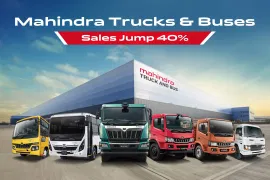 Mahindra Trucks and Buses Accelerates Growth, Logs 40% Sales Rise in JanuaryIn January, Mahindra and Mahindra’s Trucks & Buses Division showed a 40% increase in sales over the previous year, selling a cumulative total of 3,065 commercial vehicles. This is a positive sign for the commercial vehicle market in India, which is w...5 min readIG
By Indraroop
Wed Feb 04 2026
 Budget 2026–27 Could Deliver Major Boost to Trucks, Commercial VehiclesThe Union Budget for 2026-27 India focuses on infrastructure development, which is expected to generate long-term momentum for the trucks and commercial vehicles sector. The increase in public sector capex indicates the government's focus on improvin...5 min readIG
By Indraroop
Mon Feb 02 2026
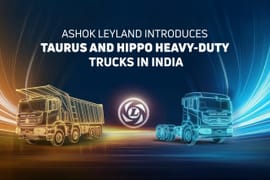 Ashok Leyland Introduces Taurus and Hippo Heavy-Duty Trucks in IndiaAfter more than half a century of silence, two of the most recognizable names in India’s heavy trucking story are coming back. Ashok Leyland is set to launch the Taurus and Hippo trucks, not as nostalgic throwbacks, but as fully re-engineered, modern...6 min readPV
By Pratham
Thu Jan 22 2026
 Mahindra Unveils New Bolero Camper and Pik-Up Range with Fresh Design, Features and Comfort FeaturesBeing a prominent manufacturer of commercial vehicles in the Indian automotive industry, Mahindra & Mahindra Ltd. has introduced new variants of both the Bolero Camper model and the Bolero Pik-Up model of the Bolero series of utility vehicles, which ...5 min readIG
By Indraroop
Thu Jan 22 2026
 Tata Motors Launches Updated Ultra Truck Line-up with EV and Diesel OptionsThe Ultra name has always lived in a slightly different space. Not flashy like heavy trucks, not barebones either. It’s the range that quietly handles city runs, hub-to-hub movement, and the middle ground between last-mile and long haul. With today’s...8 min readPV
By Pratham
Tue Jan 20 2026
 Tata Motors Expands the Prima Lineup With a Mix of Electric and Diesel Heavy TrucksTata Motors has launched new trucks in their existing Prima lineup. With the latest additions to the Prima range, Tata Motors has made it clear that it isn’t betting on a single path for heavy trucking. Instead, the company has widened the Prima port...5 min readPV
By Pratham
Tue Jan 20 2026
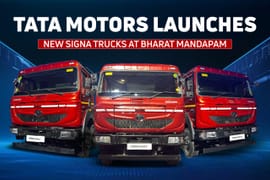 Tata Motors Launches New Signa Trucks at Bharat Mandapam Truck launches are usually loud affairs, big claims, bigger screens and a lot of words that don’t mean much once you leave the hall. Today’s Signa launch at Bharat Mandapam felt different and just more confident. Tata Motors introduced six new Signa ...7 min readPV
By Pratham
Tue Jan 20 2026
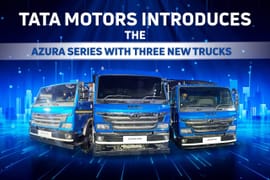 Tata Motors Introduces the Azura Series With Three New TrucksWith the introduction of the Azura series, Tata Motors has quietly reshaped its approach to the light and intermediate truck space. Instead of trying to stretch one product across multiple payload classes, the company has rolled out three separate mo...4 min readPV
By Pratham
Tue Jan 20 2026
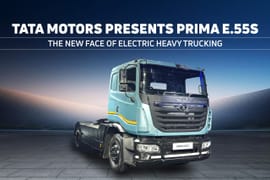 Tata Prima E.55S Unveiled at Bharat Mandapam: Electric Heavy-Duty Truck in FocusToday, at the Bharat Mandapam event, Tata Motors rolled out 17 new trucks in various model and engine variants. All trucks are ECE R29.03 European Cabin Safety Regulation-compliant, providing greater safety for passengers with improved strength and r...8 min readJS
By Jyoti
Tue Jan 20 2026