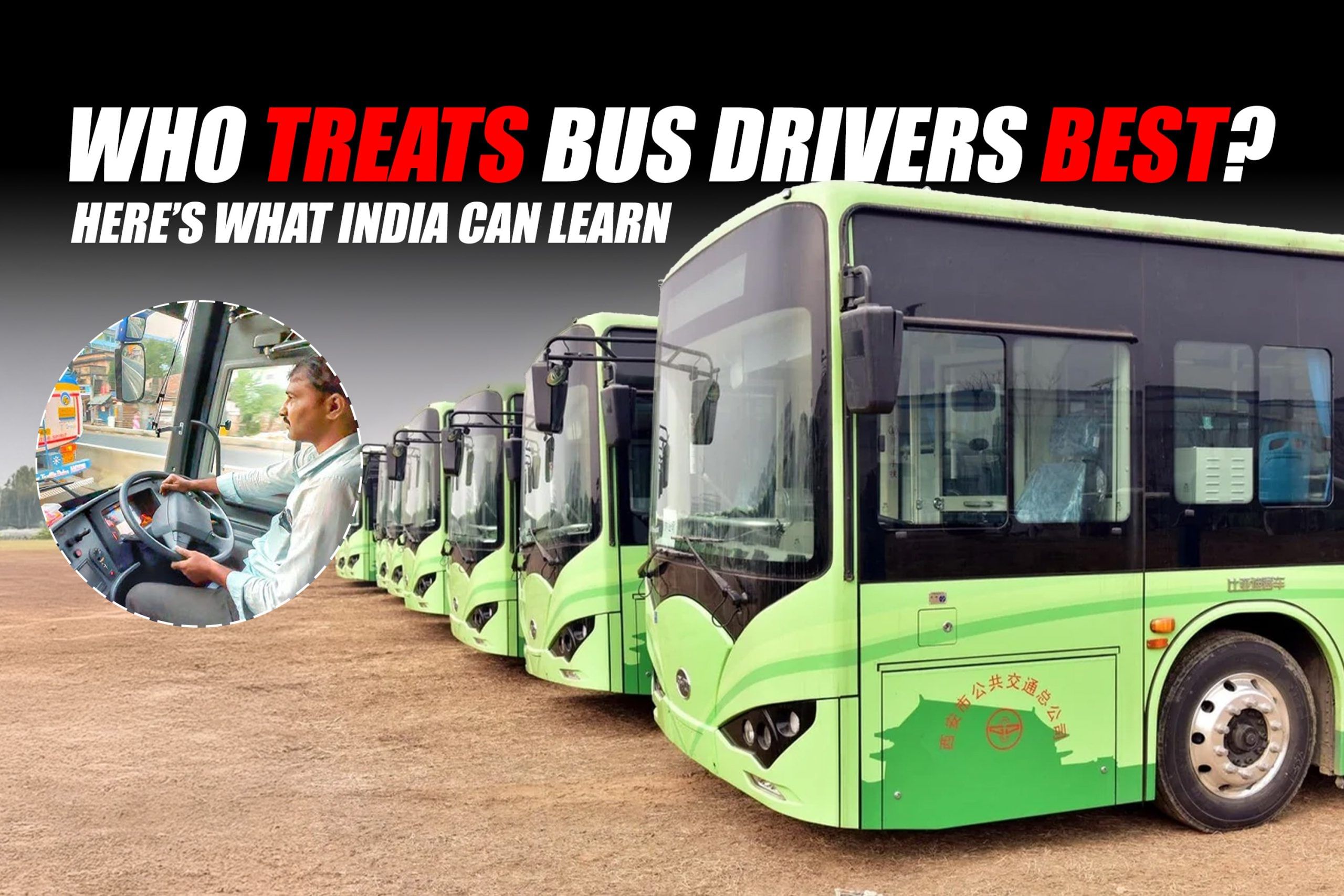
In any transportation network, the bus operator plays a vital role. Every day they operate a city full of passengers, connecting people and connecting our economies. The quality of life for the bus operator in one country is much different than the quality of life of a driver in another country. In some nations, operators have laws, safety systems and respect; while in other nations, drivers deal with fatigue and deplorable conditions.
This article studies three nations Sweden, Germany and Canada where bus driver quality of life stands high. It also explores what India can learn to improve driver comfort, safety and dignity.
1. Sweden – Welfare at the Core of Work
Sweden treats its bus drivers as essential workers, not as replaceable operators. Here, welfare defines the job.
Work and Pay:
Drivers make between around SEK 30,000 and 35,000 a month (₹2.3–2.7 lakh). Hours do not budge and overtime is rarely mandated. Work-life balance is legally enforceable. Every driver completes their shift on time and heads home without calls to work late or added extra long routes.
Safety and Comfort:
Swedish buses use ergonomic seats, climate control and insulated cabins. Many have fatigue sensors, blind-spot alerts and lane assist. These features protect both driver and passenger. When comfort improves, safety improves.
Support and Rights:
Unions remain active, healthcare and pensions are included as basic benefits. The outcome assured drivers, safe roads and reliable service. Sweden's model shows that when welfare comes first, efficiency is next.

2. Germany – Discipline, Respect and Structure
Germany's transport system mirrors that discipline. Every rule has a reason and every driver has rights.
Pay and Benefits:
In Germany bus drivers can earn approximately €2,800–3,200 monthly (₹2.5–2.9 lakh). Training remains regular, covering road safety, passenger care and technology updates. Their profession evolves, not stands still.
Working Environment:
Driving hours stay capped. Rest breaks stay enforced. Fatigue counts as a system issue, not personal weakness. Vehicles from MAN or Mercedes-Benz feature air-suspension seats, adjustable controls and quiet cabins all aimed at better posture and reduced strain.
Safety Framework:
Each bus faces scheduled inspection. GPS and route-monitoring systems track driving behaviour. Respect runs deep. Passengers value their drivers; employers treat them fairly.
3. Canada – Balance Between Efficiency and Empathy
Canada balances technology with care. Its transport system functions with both precision and compassion.
Wages and Scheduling:
Canadian drivers earn somewhere around CAD 28–32 per hour (₹1,700–1,950). Shifts remain organized, rest periods protected and overwork discouraged. This schedule keeps performance high without draining energy.
Facilities and Design:
Depots in cities like Toronto and Vancouver include clean restrooms, lounges and cafeterias. Inside the bus, hydraulic steering, soft seating and climate systems enhance comfort. A driver who rests well drives well.
Public outreach campaigns and union organizing events honor their work. Drivers are viewed as public servants — necessary, trained and worthy of respect. Canada creates a structure in which bus driver working conditions improve morale and service quality simultaneously.
Life of the Bus Driver in India – It Still Isn't Easy
In India, this story looks different, bus drivers keep the country moving, but they work long hours, often in burning heat, for little pay.
Current Conditions:
A typical bus driver will earn between ₹15,000 - 40,000 a month. Many drive 12-16 hours a day, in heavy traffic, on terrible roads and in inconsistent weather conditions, all with very little process, period, or good facilities to rest.
Major Problems
- Hours worked leads to fatigue, which means decreased alertness.
- Many depots do not have restrooms or canteens.
- Training is minimal on best practices of safety or basic care of the vehicle.
- Their social standing stays low, despite the important work they do.
But the tide is turning. Electric buses, ergonomically designed cab-in-cabs and automated buses from Tata Motors, JBM or Ashok Leyland show early proof of consideration. The question is, how can we prioritize the human being driving the vehicle, as much as thinking about the machine on the road?
What India can learn
Fix Working Hours:
Drivers need a legal limit on their driving time, with time built into their schedules to take breaks. Fatigue management should be a national policy.
Focus on Comfort:
Bus interiors must include supportive seats, air-conditioning and low vibration levels. These small changes reduce stress and accidents.
Build Financial Security:
Insurance, pension and medical support should form a fixed part of every contract.
Train and Recognize:
Drivers need regular safety and skill certification and society must acknowledge their role with respect.
Upgrade Depot Infrastructure:
Every terminal should provide clean restrooms, resting lounges and first-aid rooms.
When these steps align, driver life and passenger safety rise together.
Conclusion
Across Sweden, Germany and Canada, bus drivers work with dignity. Their pay sustains families, their schedules protect health and their society respects effort. Each system proves that good work culture starts with trust and ends with safety.
For more articles and news, stay updated with 91trucks. Subscribe to our YouTube channel and follow us on Facebook, Instagram and LinkedIn for the latest videos and updates from the automotive world!
Related Stories:
Commercial Vehicle Accessories Market to Reach USD 179.42 Billion by 2034
Top 5 Tips for Driving Buses Safely in Fog and Low Visibility
Web Stories
Latest Buses News
 Tata Motors Bags Orders for More Than 5,000 Buses from State Transport UndertakingsTata Motors has received an order from several state transport undertakings (STUs) across India to deliver more than 5,000 buses and/or bus chassis. The order includes transport corporations located in the states of Maharashtra, Gujarat, North Wester...3 min readIG
By Indraroop
Mon Mar 16 2026
 GreenCell Mobility Plans Deployment of 570 Electric Buses to Expand Delhi’s Public Transport NetworkDelhi has been expanding its clean mobility space as 570 electric buses are being readied to be deployed across Delhi in the next few months by GreenCell Mobility. This move complements Delhi’s efforts in enhancing its zero-emission public transporta...4 min readIG
By Indraroop
Mon Feb 09 2026
 Zingbus Expands EV Push with 50 Electric Buses Planned for 2026, Eyes 1,000 by 2030Zingbus, the India-based intercity travel platform, has announced a strategic expansion of its electric bus rollout, planning to deploy 50 new electric buses in 2026 as part of a broader mobilisation towards cleaner, long-distance travel. This initia...4 min readIG
By Indraroop
Fri Feb 06 2026
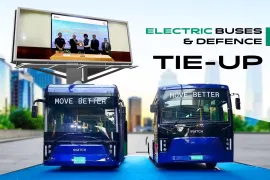 Ashok Leyland Signs MoU with PT Pindad for Electric Bus and Defence Vehicle ProjectsIndian bus and commercial vehicle manufacturer Ashok Leyland has signed a strategic Memorandum of Understanding (MoU) with Indonesian state-owned defence and industrial company PT Pindad to jointly work on the development of electric buses and defenc...3 min readIG
By Indraroop
Thu Feb 05 2026
 Mahindra Trucks and Buses Accelerates Growth, Logs 40% Sales Rise in JanuaryIn January, Mahindra and Mahindra’s Trucks & Buses Division showed a 40% increase in sales over the previous year, selling a cumulative total of 3,065 commercial vehicles. This is a positive sign for the commercial vehicle market in India, which...4 min readIG
By Indraroop
Wed Feb 04 2026
 Telangana Invites Lady Drivers to Take Command of Public Buses Marking a Significant Milestone Telangana has deliberately included women in the mainstream of their transportation services workforce by calling for expressions of interest from women to join as bus drivers for the first time as part of this systemic government-level initiative. T...4 min readIG
By Indraroop
Tue Dec 23 2025
 From Tata Winger to Force Urbania and More: Top-4 Tempo Travellers for Family Roadtrips This WinterSUVs and MPVs are hot favourites among Indian families. But when it comes to taking the extended families on long road trips this 2025 winter, a tempo traveller can provide all the comforts that no passenger vehicle can claim to offer. So move over I...4 min readPV
By Pratham
Fri Dec 19 2025
 Zingbus Grows Electric Bus Fleet via New Operator Partnership ModelIntercity smart mobility technology platform Zingbus has scaled up its EV initiative by aggregating fleets through partnerships with bus operators rather than owning and operating the fleet all by themselves. It has moved away from a Company-Owned, C...3 min readIG
By Indraroop
Tue Dec 02 2025
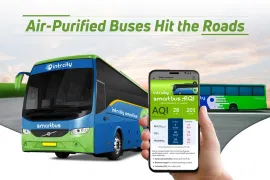 IntrCity Rolls Out Advanced Air-Purified Intercity Bus Fleet Across North IndiaIntrCity SmartBus has deployed a new fleet of air-purified coaches on key intercity corridors in North India, amid growing concern about air quality during long-distance travel. The rollout introduces SmartBus.AQI, a service built around continuous i...4 min readIG
By Indraroop
Mon Nov 24 2025
 Is It Time to Retire Sleeper Buses?Sleeper buses used to feel like a reasonable option for long-distance travel, comfortable, inexpensive and quick. But two recent tragedies and the growing evidence of system failures, raises a bigger question: Should we say farewell to sleeper buses?...7 min readJS
By Jyoti
Tue Nov 18 2025