Volvo Diesel Buses in India
Volvo Diesel buses are designed around the realities of daily life for passengers, where change is never constant and expectations are always unpredictable. They are not designed for a single function. They are designed to accommodate change, whether that change is demanded by the movement of people in cities, institutions, or even between cities.
What becomes apparent is their capacity to provide continuity. The focus is still on efficiency of use, strength of construction and a driving experience that is never taxing, even through long hours of operation.
Price List of Volvo Diesel buses in India
| Model | Price |
|---|---|
| 9400 B11R | ₹1,20,00,000 |
| B9R | ₹1,50,00,000 |
| 9400 B8R | ₹1,35,00,000 |
| Last Updated: Oct 12, 2026 | |
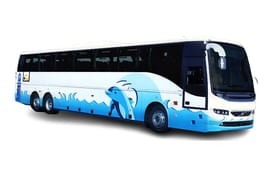
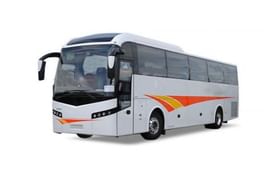
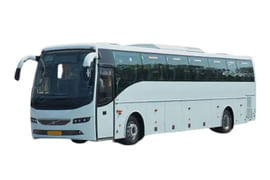
Most Popular Comparison
Popular Volvo Diesel Buses in India
The Volvo Diesel offers several variants, though some like 9400 B11R have over time become more visible. This does not mean that they have one outstanding feature that sets them apart. Rather, it’s the combination of several factors that make it practical to have such seating arrangements, balanced running costs and an overall configuration that mirrors real-world conditions.
There are some models that are obviously more geared towards city driving, where frequent stops are part of the package. Others are obviously more geared towards longer distances, where passenger comfort becomes an issue.
Volvo Diesel Bus Price in India
If you look at the pricing, the pricing of Volvo Diesel buses goes from ₹1,20,00,000 to ₹1,50,00,000 but the differences are significant when you look closely at what the buses are designed for. The key differences between the buses are seating capacity, body type and how those options affect the configuration of the bus. For example, a bus that has been designed for a short-distance trip versus a longer-distance trip will have a less-expensive configuration than a longer-distance bus because there are more seats in the passenger section of the bus.
Key Features of Volvo Diesel Buses in India
-
Engineered for consistent performance across varying passenger loads
-
Cabin layouts that prioritize space without overcomplicating design
-
Chassis strength aligned with regular, high-frequency usage
-
Balanced approach to efficiency and output
-
Driver-focused ergonomics that reduce fatigue over time
-
Configurations that remain adaptable to different route demands
Applications of Volvo Diesel Buses in India
In practice, Volvo Diesel buses find use across a wide spread of transport needs. They do not restrict themselves to a narrow segment. Instead, they move across roles, depending on how they are configured.
Typical applications include staff transport, school and institutional movement, city-level passenger operations and even contract-based travel services. In many cases, the same platform supports multiple uses with minimal adjustments.
Mileage and Performance of Volvo Diesel Buses in India
Performance, in this sense, is no longer about achieving high numbers. Volvo Diesel buses are designed to maintain performance at all times, whether it’s in heavy traffic or on open roads.
Mileage varies naturally based on load, road conditions and driving styles. However, in all these cases, there is a sense of predictability that is often underestimated. This predictability comes in handy when time and cost factors come into play.
Why Choose Volvo Diesel Buses in India
The decision to opt for a Volvo Diesel bus is rarely impulsive. It usually reflects a longer-term view of operations.
-
Strong brand presence that supports continued usage
-
Service network that remains accessible across regions
-
Resale value that holds better over time
-
Maintenance requirements that stay within reasonable limits
-
Flexibility to align with varied passenger transport needs
Compare Volvo Diesel Bus Models at 91trucks
Buyers can also compare different Volvo Diesel buses on 91trucks based on parameters such as price, seating capacity, performance and usability. This helps in making a clear decision when all the alternatives seem similar.
A clear decision usually follows. And in most cases, that makes all the difference in the long run.