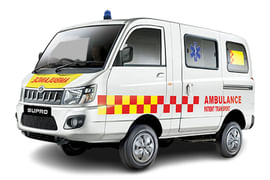
Mahindra Ambulance Buses in India
Mahindra Ambulance buses meet a wide range of passenger transport needs, where operating environments are rarely consistent. To be able to reliably carry out service these buses need to have a design that can be capable in a wide range of load and road conditions ranging from heavy use in city corridors to longer distance intercity operation.
There is no heavy emphasis given to any one aspect. There is room for all, depending on need or expectation. Depending on the form, the same bus can be used for completely different purposes without ever looking out of place. This, over time, counts for more than any other aspect.
Price List of Mahindra Ambulance Buses in India
| Model | Price |
|---|---|
| Jeeto Minivan | ₹3.57 Lakh |
| E-Supro Van | ₹4.38 Lakh |
| Supro Van | ₹6.32 Lakh |
| Supro Minivan | ₹6.88 Lakh |
| Supro School Van | ₹6.19 Lakh |
| Last Updated: Sep 14, 2026 | |
Most Popular Comparison
Popular Mahindra Ambulance Bus Models in India
In the Indian market, Mahindra has managed to create a range of buses that cover all possible scenarios for the usage of these vehicles. There are buses designed for high-frequency routes with continuous passenger flow and others designed for long routes.
What drives their popularity is not a single defining factor, but a combination of elements working together:
-
Practical layouts that align with real-world passenger movement
-
Engine performance that remains stable across fluctuating loads
-
Operating efficiency that supports daily usage without sharp cost escalations
-
Market familiarity, which often influences buying decisions more than expected
Certain models, over time, have gained wider acceptance simply because they deliver what operators actually need, nothing overstated, nothing lacking.
Mahindra Ambulance Bus Price in India
Pricing within this category is fluid. It can change, subtly or dramatically, depending on configuration, intended use and degree of flexibility.
The general price band is usually 0 to ₹31.95 Lakh, but this band should not be considered in isolation. Behind it is a triad of variables:
-
Seating arrangement and internal layout decisions
-
Engine specifications and fuel compatibility
-
Application-specific modifications
-
Additional features that may or may not be essential depending on usage
As a result, two buses within the same category can differ meaningfully in price, even if they appear similar at a glance.
Key Features of Mahindra Ambulance Buses in India
The feature set of Mahindra Ambulance buses focuses less on excess and more on functional reliability:
-
Engine options designed for sustained commercial usage
-
Configurations that optimize passenger capacity without overcrowding
-
A structurally sound chassis built for long-term durability
-
Suspension systems that absorb variations in road quality effectively
-
Fuel efficiency that supports controlled operating costs
-
Driver-centric layouts that simplify control and reduce fatigue
These are not headline-grabbing features individually. Taken together, though, they define the vehicle’s everyday usability.
Applications of Mahindra Ambulance Buses in India
The operational scope of these buses extends across multiple passenger transport segments:
-
Organized staff and employee movement
-
School and institutional transportation services
-
City-based and intercity passenger routes
-
Tourism and contract carriage operations
-
Connectivity across semi-urban and rural regions
In practice, deployment often depends less on capability and more on how the operator chooses to configure the vehicle.
Mileage and Performance of Mahindra Ambulance Buses in India
Here, performance isn’t about achieving a peak output but more about consistency. Mahindra Ambulance buses are built to accommodate regular challenges, frequent stops, varying passenger loads and long operating hours, all without putting too much pressure on the system. Mileage figures will always differ from one condition to another. There are a lot of factors to take into account. However, the underlying purpose remains the same: to provide efficiency without compromising on performance.
There’s a certain level of predictability when it comes to such buses and when it comes to practical use, predictability beats performance.
Why Choose Mahindra Ambulance Buses in India?
The decision to opt for a Mahindra Ambulance bus is rarely based on a single parameter. It tends to build on a combination of long-term considerations:
-
Established brand presence with dependable service infrastructure
-
Consistent resale value across different markets
-
Service networks that reduce downtime pressures
-
Manageable maintenance cycles over extended usage
-
Configurations that adapt to varied operational needs
Individually, these may seem standard. Collectively, they shape ownership experience in a more tangible way.
Compare Mahindra Ambulance Bus Models at 91trucks
For buyers looking at their options in this category, the comparison is an inevitability rather than just an opportunity. On 91trucks, various Mahindra Ambulance models can be compared on price, seating layout, mileage, engine size and feature set.
With options ranging from 0 to ₹31.95 Lakh and a multitude of configurations, the decision is less about guesswork and more about your specific operational requirements